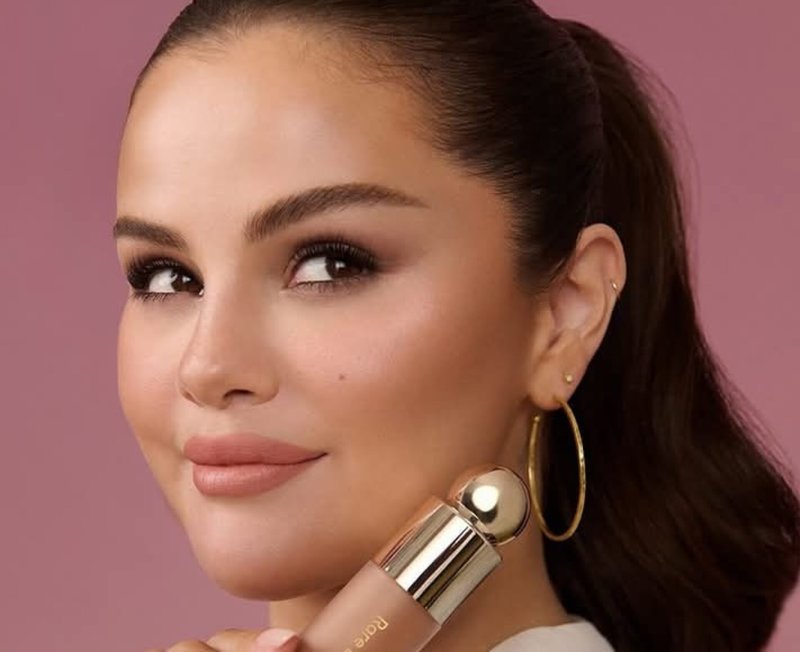
The Rare Impact Fund: Strategy, Not Charity
Before Rare Beauty sold its first unit, Selena Gomez committed 1% of all annual sales to the Rare Impact Fund — a pledge aimed at raising $100 million for mental health services and education by 2030. This was not a marketing footnote. It was the structural foundation of the brand's identity, announced at launch and embedded in every subsequent conversation about what Rare Beauty was and why it existed.
The business logic behind this move is more sophisticated than it appears. Mental health as a brand pillar accomplished several things simultaneously. It gave Rare Beauty a reason to exist beyond lip color and foundation — a "why" that connected to Selena's own public health journey (her lupus diagnosis, her kidney transplant, her candid discussions about anxiety and depression). It created a community of customers who felt their purchase was doing something beyond looking good. And it established a narrative that no competitor could replicate without appearing derivative or opportunistic.
L'Oréal could not launch a competing mental health beauty brand without it looking cynical. NARS could not pivot to wellness without abandoning decades of edge positioning. The pillar worked as a moat precisely because it was authentic — rooted in Selena's biography in a way that made imitation structurally impossible.
By early 2025, the Rare Impact Fund had distributed over $10 million to mental health organizations across the United States and internationally, ahead of its funding pace. The 1% pledge had become a proof point that the pillar was operational, not decorative.
What the Soft Pinch Blush Revealed About Brand Architecture
The Soft Pinch Liquid Blush became the most discussed beauty product on TikTok through 2022 and 2023, generating an estimated $90 million or more in annual run-rate from a single SKU. The viral trajectory of that product is worth examining not just as a sales success but as evidence of how pillar-first brand architecture performs under pressure.
The blush went viral because of its formula — buildable pigment, skin-like finish, a texture that behaved differently from anything else in the drugstore or mid-market range. But the reason the virality stuck, rather than cycling through the 48-hour TikTok memory and fading, was the brand infrastructure behind it. When a new customer discovered the Soft Pinch Blush through a video, they landed in a brand ecosystem that had a coherent story, a meaningful mission, and a founder whose authenticity had already been stress-tested by public life.
Product virality is easy to manufacture. Brand virality — the kind that converts first-time buyers into advocates who recruit their networks — requires something the product alone cannot deliver. The pillar delivered it. Customers weren't just buying blush; they were buying membership in something that cared about something.
The Ownership Structure Nobody Talks About
Rare Beauty reached a reported $2 billion valuation in 2023 without a major institutional round that dramatically diluted Selena's founding position. This is a meaningful departure from the typical celebrity brand trajectory, where a celebrity attaches their name and likeness, accepts a minority equity position in exchange for the brand infrastructure and capital, and watches institutional investors accumulate the majority of ownership through successive rounds.
Compare this to the Fenty Beauty / LVMH structure. Rihanna entered a genuine joint venture, which gave her founder-level economics and creative control, but LVMH's scale and capital came with institutional ownership. The LVMH structure was the right model for a brand that needed global luxury distribution immediately. Selena chose a different path: Rare Beauty launched with Kendo Holdings (a LVMH subsidiary, notably) providing operational infrastructure, but the brand's clean positioning and Sephora exclusivity allowed growth to compound without the pressure of institutional investors pushing toward premature exit or aggressive expansion.
The result is a brand where Selena's economic interest remained substantial through a valuation trajectory that most celebrity brands never approach. The $2 billion figure, if accurate, implies a founder equity position worth hundreds of millions at current valuation — not a flat fee, not a small royalty stream, but a stake in a company she helped build into a legitimate category leader.
From Endorser to Operator: The Mindset That Made It Work
The most significant shift in Rare Beauty's story is not financial — it is cognitive. Selena Gomez stopped thinking like an endorser and started thinking like an operator. These are not the same orientation. An endorser asks: "Does this product reflect my image?" An operator asks: "Does this product decision strengthen the long-term position of the company?"
The operational choices Rare Beauty made reflect founder-level thinking at every stage. Clean beauty positioning was chosen not because it was fashionable in 2020 — it was — but because the mental health pillar demanded formulation integrity. A brand built on "being kind to yourself" cannot sell products with ingredients customers have to research to feel comfortable with. The clean commitment was a consequence of the pillar, not a marketing trend they chased.
Sephora exclusivity was chosen over broad mass-market distribution because the brand needed to control the retail environment, the sales associate narrative, and the customer discovery experience. A Sephora purchase is a considered purchase; a drug store impulse buy tells a different story about who the brand is for. International rollout was sequenced thoughtfully — markets where Selena had genuine fan infrastructure first, allowing the brand story to travel through authentic cultural connections rather than paid media alone.
These decisions are operator decisions. They reflect someone who had read the brand strategy, understood the financial model, and cared about the long-term equity of the company beyond the quarter's sell-through numbers.
The Pillars That Make Brands Defensible in 2025
The Rare Beauty case established a template that the celebrity beauty market has been processing since its launch. The lesson is not "launch a mental health brand." The lesson is: choose a pillar that is (a) authentic to the founder's biography, (b) meaningful enough that customers feel genuine alignment with it, and (c) structurally impossible for competitors to replicate without inauthenticity.
Three categories of pillar meet these criteria in the current market. Mental health, as Selena demonstrated, works when the celebrity's own story is genuine and the operational commitment — a fund, a partnership, a measurable pledge — makes it concrete rather than aspirational. Sustainability and environmental responsibility work when the supply chain actually reflects the claim, and when the founding story connects the celebrity's cultural identity to the cause in ways that feel earned rather than adopted. Cultural identity — particularly the assertion of underrepresented heritage, language, aesthetics — works when the celebrity is building a bridge between their community and the mainstream market rather than simply mining their identity for commercial appeal.
For LatAm celebrities, cultural identity is perhaps the most potent and underdeployed pillar available. Audiences across Mexico, Brazil, Colombia, Argentina, and the broader diaspora are hungry for beauty brands that reflect their skin tones, their aesthetic sensibilities, their cultural references — built by someone who shares that identity, not a multinational corporation that surveyed the opportunity. That pillar, built on authentic biography and executed with Rare Beauty's level of operational discipline, is the template for what defensible celebrity brand building looks like in 2025 and beyond.