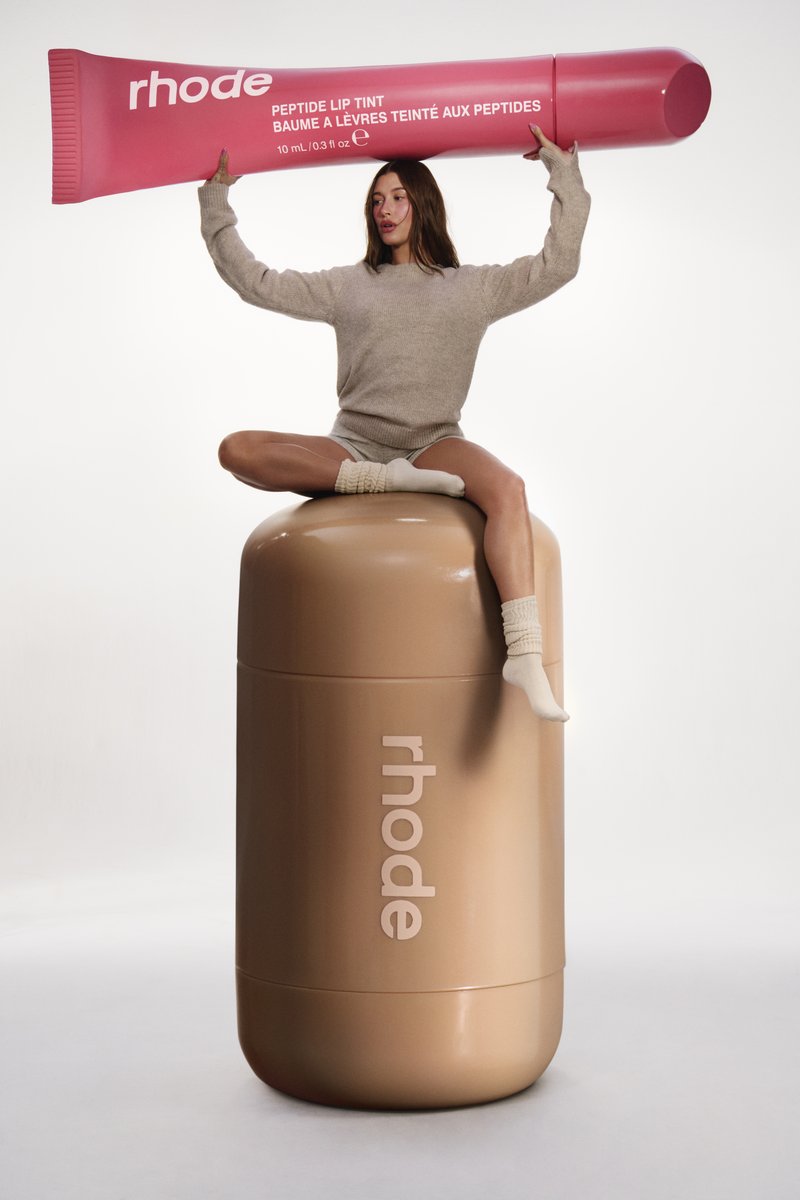
The narrow launch was the whole strategy
Rhode opened with exactly three products — a Peptide Lip Treatment, a Barrier Restore Cream, and a Peptide Glazing Fluid — sold only through rhodeskin.com. That was not a soft launch working toward something bigger. That was the commercial posture: three hero SKUs at premium price points, with no dilution from shoulder products, accessories, or line extensions during the critical first eighteen months.
The narrow range forced marketing discipline. Every Hailey post, every interview, every campaign shot tied back to the same three products. Repetition built recognition. Recognition built demand. Demand outran supply within weeks of launch and stayed that way for over a year. Product shortages were not a failure of operations — they were the mechanism by which scarcity compounded desire. A product every consumer could always get would have been a product they stopped thinking about.
DTC control preserved pricing power
For the first two years, Rhode was available in exactly one place: its own website. No Sephora, no Ulta, no Nordstrom, no Target. That was not a distribution failure. That was a valuation decision. DTC-only meant the brand owned one hundred percent of the customer relationship, one hundred percent of the pricing architecture, and one hundred percent of the gross margin that wholesale partners would otherwise have captured. It also meant every customer was traceable — every email captured, every preference recorded, every repeat purchase mapped — which is the exact data a retail acquirer pays a premium to inherit.
The Sephora partnership announced in 2024 was the structural inflection. Rhode moved from DTC-only to full Sephora distribution at a moment when its unit economics were already proven. The retailer was not acquiring access to an unproven indie brand — it was acquiring access to a brand that had already demonstrated product-market fit at significant scale. That bargaining position produced premium wholesale terms, and the retail rollout added distribution without diluting the brand's premium positioning.
The founder is operationally present
Hailey Bieber is not a figurehead at Rhode. The product decisions run through her. The campaign creative runs through her. The packaging, the texture, the scent, the positioning — all founder-driven. Co-founders Lauren Rothberg (creative) and Michael D. Ratner (operator) provided the infrastructure that let Hailey's founder attention translate into consistent product decisions, but the founder was not outsourced. Compare that to endorsement-era celebrity brands where the celebrity signs off on a logo and a campaign shoot and has no involvement in the product itself. Those brands do not produce billion-dollar exits, because the consumer can sense the absence.
Narrow range, controlled distribution, operationally-present founder. Those are the three decisions that compressed a five-year beauty-exit timeline into three years.
The exit math — $800M upfront, $200M earnout
E.l.f. Beauty's May 2025 acquisition was structured as $800 million in cash and stock at closing, with up to $200 million in earnout tied to revenue milestones. The cash-and-stock component matters: Hailey's personal outcome from the transaction is estimated in the high hundreds of millions, and the stock portion gives her continued upside from e.l.f.'s equity performance over the earnout period. That is a different structure from a pure cash buyout, and it signals the acquirer's belief that the brand continues to compound under new ownership — which in turn supports the earnout hitting its milestones.
What replicates, and what doesn't
The structural elements of the Rhode playbook are fully replicable. A Latin American artist at Hailey's level of audience authority, partnered with a manufacturing backbone of Korean formulators and a DTC-first distribution strategy, could compress the same timeline. The non-replicable element is Hailey's specific cultural moment — the "glazed skin" aesthetic she defined became a TikTok category that effectively pre-marketed the Rhode product line. But cultural moments are category-specific and region-specific. A comparable moment exists right now in Latin American beauty that no celebrity has yet claimed at scale. The first to claim it will be the next $1 mil M three-year exit.